Website owner: James Miller
Cauchy’s integral formulas, Cauchy’s inequality, Liouville’s theorem, Gauss’ mean value theorem, maximum modulus theorem, minimum modulus theorem
Cauchy’s integral formulas
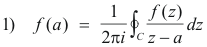
Theorem 1. If f(z) is analytic inside and on the boundary C of a simply-connected region R and a is any point inside C then
where C is traversed in the positive direction. Proof
In addition the n-th derivative of f(z) at z = a is given by

where C is traversed in the positive direction. Proof
Formula 1) above can be considered a special case of 2) with n = 0 if we define 0! = 1.
Formulas 1) and 2) above are known as Cauchy’s integral formulas.
It can be shown that Cauchy’s integral formulas are valid not only for simply-connected regions but also for multiply-connected ones. Proof
Theorem 2. If a function f(z) is analytic inside and on the boundary C of a simply-connected region R, then all its higher order derivatives exist and are analytic in R.
Cauchy’s integration formulas reveal the remarkable fact that if a function is analytic within a simply-connected region R and C is any simple closed curve within R then the values of the function and all of its derivatives, at all points within C, are completely determined by the values of the function along C (i.e. the values of a function and all its derivatives are fixed by the values of the function along C). In fact, it can be shown that if in a region R two analytic functions are given that agree on some curve C within R, then they agree on the entire region. If we know the values of an analytic function on some segment of a curve in a region, then the values of the function are uniquely determined everywhere in the region. Thus we see that the values of an analytic function in different parts of the complex plane are closely connected to one another. To appreciate the significance of this we need remember that the general definition of a function of a complex variable allows any correspondence between the values of the argument and the values of the function i.e. the function may assign any value whatever to any point z. Such a definition gives no possibility of determining values of a function at some point from its values in another part of the plane. We thus see that the single requirement of differentiability of a function of a complex variable is so strong that it forces a connection between values of the function at different places.
Some important theorems
Following are some important theorems that are consequences of Cauchy’s integral formulas.
1. Cauchy’s inequality. If f(z) is analytic inside and on a circle C of radius r and center at a, then

where M is a constant such that |f(z)| < M on C, i.e. M is an upper bound of |f(z)| on C. Proof
2. Liouville’s theorem. If f(z) is analytic in the entire complex plane and is bounded (i.e. |f(z)| < M for some constant M) then f(x) must be a constant. Proof
3. Fundamental theorem of algebra. Every polynomial equation of degree n
 1 with
complex coefficients has at least one root. Proof
1 with
complex coefficients has at least one root. Proof
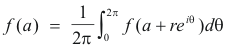
4. Gauss’ mean value theorem. Let f(z) be analytic inside and on a circle C of radius r and center at a. Then f(a) is the mean of the values of f(z) on C, i.e.
5. Maximum modulus theorem. Let f(z) be analytic on a closed region R with boundary C and let M be the maximum value assumed by |f(z)| in R. Then, if f(z) is not identically equal to a constant, the maximum value M of |f(z)| occurs on the boundary C. In addition, at all points on the interior of R, |f(z)| < M.
In other words, a function that is analytic in a region assumes its maximum value on the boundary of the region and not in the interior providing it is not a constant.
6. Minimum modulus theorem. Let f(z) be analytic on a closed region R with boundary
C and let
 be the minimum value assumed by |f(z)| in R. Then, providing f(z)
 0 throughout
R, the minimum value
0 throughout
R, the minimum value
 of |f(z)| occurs on the boundary C. In addition, at all points on the
interior of R, |f(z)| >
of |f(z)| occurs on the boundary C. In addition, at all points on the
interior of R, |f(z)| >
 .
.
In other words, a function that is analytic in a region assumes its minimum value on the boundary of the region and not in the interior providing it is not identically zero.
References
Mathematics, Its Content, Methods and Meaning
James and James. Mathematics Dictionary
Spiegel. Complex Variables (Schaum)
Wylie. Advanced Engineering Mathematics
Hauser. Complex Variables with Physical Applications.
Jesus Christ and His Teachings
Way of enlightenment, wisdom, and understanding
America, a corrupt, depraved, shameless country
On integrity and the lack of it
The test of a person's Christianity is what he is
Ninety five percent of the problems that most people have come from personal foolishness
Liberalism, socialism and the modern welfare state
The desire to harm, a motivation for conduct
On Self-sufficient Country Living, Homesteading
Topically Arranged Proverbs, Precepts, Quotations. Common Sayings. Poor Richard's Almanac.
Theory on the Formation of Character
People are like radio tuners --- they pick out and listen to one wavelength and ignore the rest
Cause of Character Traits --- According to Aristotle
We are what we eat --- living under the discipline of a diet
Avoiding problems and trouble in life
Role of habit in formation of character
Personal attributes of the true Christian
What determines a person's character?
Love of God and love of virtue are closely united
Intellectual disparities among people and the power in good habits
Tools of Satan. Tactics and Tricks used by the Devil.
The Natural Way -- The Unnatural Way
Wisdom, Reason and Virtue are closely related
Knowledge is one thing, wisdom is another
My views on Christianity in America
The most important thing in life is understanding
We are all examples --- for good or for bad
Television --- spiritual poison
The Prime Mover that decides "What We Are"
Where do our outlooks, attitudes and values come from?
Sin is serious business. The punishment for it is real. Hell is real.
Self-imposed discipline and regimentation
Achieving happiness in life --- a matter of the right strategies
Self-control, self-restraint, self-discipline basic to so much in life