Website owner: James Miller
Measurable functions. Theorems. Baire classes. Egorov’s theorem.
Def. Measurable function. Let f(x) be a real-valued function defined on a measurable set E. The function f(x) is said to be (Lebesgue) measurable if for any real number α the set of all x for which f(x) > α is measurable.
Let us consider this concept more carefully. Let us denote by
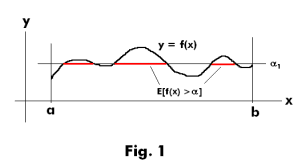
E[f(x) > α]
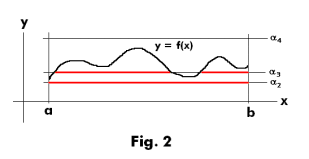
that set of values x ε E for which f(x) > α . Consider the function y = f(x) shown in Fig. 1, defined on the open interval (a, b). Here the set E corresponds to the real numbers in the interval (a, b). A value of α = α1 is shown and the red line segments indicate the subset of E for which f(x) > α. In Fig. 2 some other values for α are shown along with the subsets of E for which f(x) > α. The function f(x) is called measurable only if all these subsets of E for the different values of α are measurable.
Theorems
1. The function f(x) is measurable on a measurable set E if and only if for each real number α one of the following sets is measurable
(a) E[f(x) < α]
(b) E[f(x)
 α]
α]
(c) E[f(x) > α]
(d) E[f(x)
 α]
α]
Consequently, the above conditions represent four equivalent definitions for a measurable function.
2. If function f(x) is measurable on a set E, then E[f(x) = α] is measurable for each α. The converse is not true.
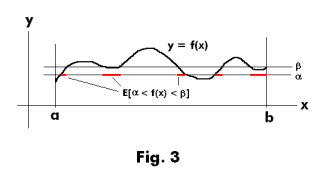
3. The function f(x) is measurable on a set E if and only if for each pair of distinct real numbers α and β, E[α < f(x) < β] is measurable. The result is also true if either one or both of the inequality symbols is replaced by ≤.
In Fig. 3 we see, in red, a point set corresponding to this criterion.
4. A function f(x) is measurable on a set E, if E[f(x) > α] is measurable for each rational number α.
5. If function f(x) is measurable on a set E1 and if E2
 E1, then f(x) is measurable on E2.
6. If f(x) is measurable on a countable class of disjoint set E1, E2, E3, ...... , then it is measurable on their union E1 ∪ E2 ∪ E3 ∪ ...
7. If f1(x) and f2(x) are measurable on a set E, then E[f1(x) > f2(x)] is measurable.
8. A constant function is measurable.
9. If function f(x) is measurable on a set E, then for any constant c, f(x) + c and c f(x) are also measurable on E.
10. If a function f(x) is measurable on a set E, then [f(x)]2 is measurable on E.
11. If f1(x) and f2(x) are measurable on a set E, then f1(x) + f2(x), f1(x) - f2(x), f1(x)f2(x), and f1(x)/f2(x) where f2(x) ≠ 0 are measurable on E i.e. the sum, difference, product and quotient of measurable functions is also measurable (the quotient only if the denominator is non-zero).
12. If f1(x) and f2(x) are measurable on a set E, then the maximum of f1(x) and f2(x) i.e. max {f1(x), f2(x)} is measurable. Similarly, the minimum of f1(x) and f2(x) i.e. min {f1(x), f2(x), is measurable.
13. If a function f(x) is measurable on a set E, then |f(x)| is measurable on E.
14. If a function f(x) is continuous on E, it is measurable on E.
15. If f1(u) is continuous and u = f2(x) is measurable, then f1(f2(x) ) is measurable. In other words, a continuous function of a measurable function is measurable. However, a measurable function of a measurable function need not be measurable.
16. Let {fn(x)}be a sequence of measurable functions on a set E. Then F(x) = l.u.b. fn(x), called the upper boundary function, and G(x) = g.l.b. fn(x), called the lower boundary function, are also measurable on E.
17. If {fn(x)} be a monotonic sequence of measurable functions on a set E such that
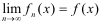 ,
,
then f(x) is measurable on E.
Note. The sequence {fn(x)}is said to be monotonic increasing if f1(x) ≤ f2(x) ≤... , monotonic decreasing if f1(x) ≥ f2(x) ≥... , and monotonic if the sequence is monotonic increasing or monotonic decreasing.
18. Let {fn(x)}be a sequence of measurable functions on a set E. Then lim sup fn(x) and lim inf fn(x) are measurable on E.
19. If a sequence {fn(x)} of measurable functions defined on a set E converges almost everywhere to a function f(x), then this function is also measurable.
20. If a function f(x) is measurable on a set E and f1(x) = f2(x) almost everywhere on E, then f2(x) is measurable on E.
An important question. If a sequence {fn(x)} of measurable functions defined on a set E converges at every point of E, except possibly at the points of a set of measure zero, then the sequence is said to converge almost everywhere. An important and central question in the theory of real variables is the following:
Q. What functions can be obtained from continuous functions by repeated application of the operation of forming the limit of an almost everywhere convergent sequence of functions and of algebraic operations?
A. Theorems 11, 14 and 19 give the answer. Continuous functions on a measurable set E are measurable and if a sequence {fn(x)} of continuous functions on E converges almost everywhere to a function f(x), then this function is also measurable. The sum, difference, product and quotient of measurable functions is also measurable.
We note that the limits of convergent sequences of continuous functions may be discontinuous. For an example, see Example 1 in Series . We thus see that the limits of convergent sequences of continuous functions, which may be discontinuous, are measurable and that the limits of these discontinuous functions are measurable, etc. We thus obtain a hierarchy of measurable functions.
Baire classes. The above considerations led Baire to give a classification of functions. A function is said to belong to the Baire class of order zero (or briefly Baire class 0) if it is continuous. A non-continuous function which is the limit of a sequence of continuous functions (i.e. functions belonging to Baire class 0) belongs to Baire class 1. In general, a function is said to belong to Baire class p if it is the limit of a sequence of functions of Baire class p - 1 but does not itself belong to any of the Baire classes 0, 1, ..... , p -1. Thus every function that belongs to some Baire class is measurable.
Egorov’s theorem. Let {fn(x)} be a sequence of measurable functions which converges to a finite limit f(x) almost everywhere on a set E of finite measure. Then given any number δ > 0, there exists a set F of measure greater than mE - δ on which the sequence converges to f(x) uniformly.
References
James and James. Mathematics Dictionary
Spiegel. Real Variables (Schaum)
Mathematics, Its Content, Methods and Meaning.
Natanson. Theory of Functions of a Real Variable
Jesus Christ and His Teachings
Way of enlightenment, wisdom, and understanding
America, a corrupt, depraved, shameless country
On integrity and the lack of it
The test of a person's Christianity is what he is
Ninety five percent of the problems that most people have come from personal foolishness
Liberalism, socialism and the modern welfare state
The desire to harm, a motivation for conduct
On Self-sufficient Country Living, Homesteading
Topically Arranged Proverbs, Precepts, Quotations. Common Sayings. Poor Richard's Almanac.
Theory on the Formation of Character
People are like radio tuners --- they pick out and listen to one wavelength and ignore the rest
Cause of Character Traits --- According to Aristotle
We are what we eat --- living under the discipline of a diet
Avoiding problems and trouble in life
Role of habit in formation of character
Personal attributes of the true Christian
What determines a person's character?
Love of God and love of virtue are closely united
Intellectual disparities among people and the power in good habits
Tools of Satan. Tactics and Tricks used by the Devil.
The Natural Way -- The Unnatural Way
Wisdom, Reason and Virtue are closely related
Knowledge is one thing, wisdom is another
My views on Christianity in America
The most important thing in life is understanding
We are all examples --- for good or for bad
Television --- spiritual poison
The Prime Mover that decides "What We Are"
Where do our outlooks, attitudes and values come from?
Sin is serious business. The punishment for it is real. Hell is real.
Self-imposed discipline and regimentation
Achieving happiness in life --- a matter of the right strategies
Self-control, self-restraint, self-discipline basic to so much in life