Website owner: James Miller
EQUATION OF THE FIRST DEGREE, THE STRAIGHT LINE
The general form of an equation of the first degree in two variables is
ax + by + c = 0 .
Its locus is a straight line. Every straight line in the plane can be represented by a first degree equation in two variables. Every first degree equation in two variables is represented by a straight line in the plane.
Special forms of the equation of a straight line.
1] Point-slope form. The equation of a straight line that passes through a point P1(x1, y1) with a slope m is
y - y1 = m(x - x1)
2] Point-intercept form. The equation of a straight line having slope m and y intercept b is
y = mx + b
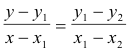
3] Two-point form. The equation of the straight line passing through points P1(x1, y1) and P2(x2, y2) is
4] Intercept form. The equation of the straight line whose x and y intercepts are a and b, respectively, is
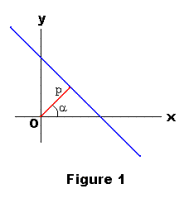

5] Normal form. The normal form of the equation of a straight line is
x cos α + y sin α - p = 0
where α is the angle from the x-axis to the perpendicular from the origin to the line and p is the length of the perpendicular. See figure 1.
General form. The general form of the equation of a straight line is
ax + by + c = 0
where a, b and c are arbitrary constants. This form includes all other forms as special cases. For an equation in this form the slope is -a/b and the y intercept is -c/b. An equation in general form can be changed to normal form by dividing by

where the sign of the radical is taken opposite to that of c if c
 0 and the same as that of b if c =
0. Thus the normal form of ax + by + c = 0 is
0 and the same as that of b if c =
0. Thus the normal form of ax + by + c = 0 is

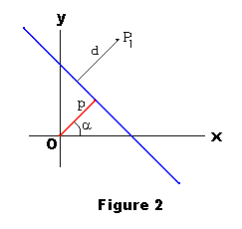
Perpendicular distance from a line to a point. The perpendicular distance d from the line ax + by + c = 0 to the point P1(x1, y1) is given by
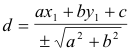
where the sign of the radical is taken opposite to that
of c if c
 0 and the same as that of b if c = 0. The
distance d is positive if P1 is on the opposite side of
the line from the origin and negative if it is on the
same side of the line as the origin.
0 and the same as that of b if c = 0. The
distance d is positive if P1 is on the opposite side of
the line from the origin and negative if it is on the
same side of the line as the origin.
Parallel lines.
1] The two lines y = m1x + b1 and y = m2x + b2 are parallel if m1 = m2.
2] The two lines a1x + b1y + c1 = 0 and a2x + b2y + c2 = 0 are parallel if a1 /a2 = b1 /b2.
Equation of a line through a point parallel to a given line. The equation of a line through the point P1(x1, y1) and parallel to line ax + by + c = 0 is
a(x - x1) + b(y - y1) = 0
Perpendicular lines.
1] The two lines y = m1x + b1 and y = m2x + b2 are perpendicular if m1 = -1/m2.
2] The two lines a1x + b1y + c1 = 0 and a2x + b2y + c2 = 0 are perpendicular if a1a2 + b1b2 = 0.
Equation of a line through a point perpendicular to a given line. The equation of a line through the point P1(x1, y1) and perpendicular to line ax + by + c = 0 is
b(x - x1) + a(y - y1) = 0
Intersecting lines.
1] Let a1x + b1y + c1 = 0 and a2x + b2y + c2 = 0 be the equations of two intersecting lines and λ an arbitrary constant. Then
(a1x + b1y + c1 ) + λ(a2x + b2y + c2 ) = 0
represents the system of lines through the point of intersection.
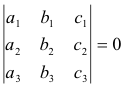
2] The three lines a1x + b1y + c1 = 0, a2x + b2y + c2 = 0, and a3x + b3y + c3 = 0 meet in a point if
Jesus Christ and His Teachings
Way of enlightenment, wisdom, and understanding
America, a corrupt, depraved, shameless country
On integrity and the lack of it
The test of a person's Christianity is what he is
Ninety five percent of the problems that most people have come from personal foolishness
Liberalism, socialism and the modern welfare state
The desire to harm, a motivation for conduct
On Self-sufficient Country Living, Homesteading
Topically Arranged Proverbs, Precepts, Quotations. Common Sayings. Poor Richard's Almanac.
Theory on the Formation of Character
People are like radio tuners --- they pick out and listen to one wavelength and ignore the rest
Cause of Character Traits --- According to Aristotle
We are what we eat --- living under the discipline of a diet
Avoiding problems and trouble in life
Role of habit in formation of character
Personal attributes of the true Christian
What determines a person's character?
Love of God and love of virtue are closely united
Intellectual disparities among people and the power in good habits
Tools of Satan. Tactics and Tricks used by the Devil.
The Natural Way -- The Unnatural Way
Wisdom, Reason and Virtue are closely related
Knowledge is one thing, wisdom is another
My views on Christianity in America
The most important thing in life is understanding
We are all examples --- for good or for bad
Television --- spiritual poison
The Prime Mover that decides "What We Are"
Where do our outlooks, attitudes and values come from?
Sin is serious business. The punishment for it is real. Hell is real.
Self-imposed discipline and regimentation
Achieving happiness in life --- a matter of the right strategies
Self-control, self-restraint, self-discipline basic to so much in life