
Website owner: James Miller
Systems of linear equations. Equivalence, independence, dependence, consistency
Systems of linear equations. Consider a system of m linear equations in the n unknowns x1, x2, .... ,xn
in which the coefficients (a’s) and the constant terms (b’s) are assumed to come from some
number field F (i.e. field of real numbers, complex numbers, etc.). By a solution of the system is
meant any set of values of
 which satisfies simultaneously the m equations.
Consistent and inconsistent systems. A system of equations is said to be consistent if it has a solution i.e. if there exists at least one set of values of the variables that satisfies all the equations. If there does not exist at least one set of values of the variables that satisfies all the equations, no solution exists and the system is said to be inconsistent. A consistent system may have just one solution or it may have infinitely many solutions.
If a linear system contains two conflicting or contradictory equations (two conflicting statements) such as
x + y = 3
x + y = 5
or
3x + 5y = 9
3x + 5y = 11
then the system will have no solution and will be inconsistent. In the case of systems containing two variables, such contradictory equations correspond to parallel lines in the plane. In the case of systems containing three variables, such contradictory equations correspond to parallel planes in space. The fact that two equations in a system are contradictory may not be immediately obvious; however, it is revealed in the process of reducing the system to simplified standard form through elementary row operations.
Example. The equations x + y = 3 and x + y = 5 are inconsistent; the equations x + y = 2 and 2x + 2y = 4 are consistent, but not independent; and the equations x + y = 4 and x - y = 2 are consistent and independent. The first pair of equations represents two parallel lines, the second represents two coincident lines, and the third represents two distinct lines intersecting in a point, the point (3,1).
Consider the system of two equations in two unknowns
a1x + b1 y + c1 = 0
a2x + b2 y + c2 = 0.
Each of the equations corresponds to a line in the plane. Such a system will have a unique solution if the lines intersect (and are not coincident). It will have no solutions if the lines are parallel (and not coincident). It will have an unlimited number of solutions if the lines are coincident.
Consider the system of three equations in three unknowns
a1x + b1 y + c1z + d1= 0
a2x + b2 y + c2z + d2 = 0
a3x + b3 y + c3z + d3 = 0.
Each of these equations corresponds to a plane in space. Any two of the planes will intersect in a straight line providing they are not parallel or coincident. The usual case is that three planes will intersect in a single point and the system will have a single unique solution. However, if two of the planes are parallel there will be no solution for the system, the system will be inconsistent. If all three planes happen to pass through a single line, then there will be a line of solutions. If it happens that all three planes are coincident, there will be a plane of solutions.
Def. Dependent equation. An equation is dependent on a set of equations if it is satisfied by every set of values of the unknowns that satisfy all of the other equations. One of three linear equations in two unknowns is dependent on the other two if the graphs of these two are not coincident and the three equations represent three lines passing through the same point.
Def. Equivalent equations. Equivalent equations are equations that have the same solution sets.
Equivalence of linear systems. Two systems of linear equations in the same number of unknowns are called equivalent if every solution of either system is a solution of the other. A system of linear equations can be transformed into an equivalent system by applying one or more of the following three elementary row operations:
(a) interchanging any two of the equations
(b) multiplying any equation by any non-zero constant
(c) adding to any equation a constant multiple of another equation.
Solving a system of equations consists of a sequence of steps in which the system is replaced by a succession of equivalent simpler systems where dependent equations are eliminated, inconsistent equations are revealed, and an easily solvable system is reached.
The third elementary operation (c) above, the addition to any equation a constant multiple of another equation, falls under the category of forming linear combinations of equations.
Def. Linear combinations of equations. For equations f(x1,x2, ... ,xn) = 0 and g(x1,x2, ... ,xn) = 0, a linear combination is defined as
h f(x1,x2, ... ,xn) + k g(x1,x2, ... ,xn) = 0
where h and k are not both zero.
Theorem. The graph of the linear combination of any two equations passes through the points of intersection of their graphs and cuts neither in any other point.
Note. This theorem applies not only to linear equations but to any equations.
Closely connected with the concept of a linear combination of equations is that of a pencil.
Example 1. Consider the two lines
f(x, y) = x + y - 4 = 0
g(x, y) = x - y - 2 = 0.
Then
h f(x, y) + k g(x, y) = h(x + y - 4 ) + k(x - y - 2 ) = 0

corresponds to a collection of lines all passing through a common point of intersection (3, 1), one line for each set of values assigned to the parameters h and k. See Fig. 1. Such a collection of lines is called a pencil of lines.
Example 2. Consider the two planes
f(x, y, z) = x + y + z - 4 = 0
g(x, y, z) = x - y - 2z - 2 = 0.
Then
h f(x, y, z) + k g(x, y, z) = h(x + y + z - 4 ) + k(x - y -2z - 2 ) = 0

corresponds to a collection of planes all passing through a common line of intersection, one plane for each set of values assigned to the parameters h and k. See Fig. 2. Such a collection of planes is called a pencil of planes.
Linearly dependent equation. An equation is said to be linearly dependent on a set of equations if it can be written as a linear combination of those equations.
Example. The equation 7x + 9y - 4 = 0 is linearly dependent on the set
of two equations
2x + 3 y + 1 = 0
x + y - 2 = 0
since
{7x + 9y - 4 = 0 } = 2{2x + 3y + 1 = 0} + 3{x + y - 2 = 0}
Linearly dependent system of equations. A system of equations is said to be linearly dependent if some one of the equations in the set is linearly dependent on one or more of the other equations in the set.
Linearly independent system of equations. A system of equations is said to be linearly independent if it contains no equations which are linearly dependent on one or more of the others in the set.
Examples. Graphs of systems of independent, dependent, consistent and inconsistent equations.
Example 1. Consider the linear system of two equations in two unknowns
a1x + b1 y + c1 = 0
a2x + b2 y + c2 = 0.

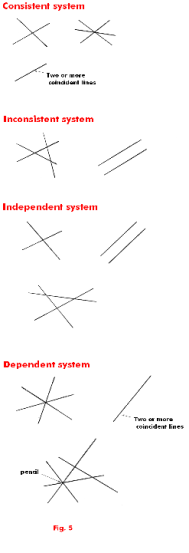
The usual case is that this system represents two lines intersecting at a point in the plane as shown in Fig. 3a, a consistent, independent system. The system could, however, represent a set of parallel lines as shown in Fig 3b, an inconsistent, independent system. It could also represent a set of coincident lines as shown in Fig. 3c, a consistent, dependent system with an infinity of solutions.

Example 2. Consider the linear system of three equations in two unknowns
a1x + b1 y + c1 = 0
a2x + b2 y + c2 = 0
a3x + b3 y + c3 = 0.
The usual case is that the system represents three lines intersecting at three different points as shown in Fig 4a, an inconsistent, independent system. It could be, however, that one of the equations is dependent on the other two, in which case we would have a pencil of three lines as shown in Fig. 4b, a consistent, dependent system. It could also be that the three equations are multiples of each other and represent a set of three coincident lines as shown in Fig. 4c, a consistent, dependent system.
Given an equation of m equations in two unknowns
a1x + b1 y + c1 = 0
a2x + b2 y + c2 = 0
............................
amx + bm y + cm = 0
Fig. 5 illustrates the concepts of consistent and inconsistent systems and dependent and independent systems.
Generally speaking, if a system of equations contains the same number of equations as unknowns there will be a unique solution. The exceptions to the rule are the following cases:
1) the system is inconsistent
2) some of the equations in the system are dependent.
If a system of equations contains more equations than unknowns then some of the equations in the system must be dependent in order for a solution to exist. If there are m equations and n unknowns and the system is consistent and m > n, then m - n of the equations must be dependent in order for a solution to exist.
On the linear dependence or independence of a set of linear equations. A linear
equation
a1x1 + a2x2 + ... + anxn = b
can be represented by the n-tuple (a1, a2, ... , an, b). A set of linear equations
a11x1 + a12x2 + ... +a1nxn = b1
a21x1 + a22x2 + ... +a2nxn = b2
...........................................
am1x1 + am2x2 + ... +amnxn = bm
can be represented by the set of n-tuples
( a11, a12, ..., a1n, b1 )
( a21, a22, ..., a2n, b2 )
............................
( am1, am2, ..., amn, bm ) .
A set of linear equations is linearly dependent or independent according as to whether their set of n-tuples are or are not linearly dependent or independent. The n-tuples can be viewed as vectors in n-space and the question of the linear dependence or independence of the equations translates directly into the question of the linear dependence or independence of the set of n-tuples. The elementary row operations performed on sets of linear equations in reducing them to canonical form correspond directly to elementary row operations performed on their n-tuples.
References
James / James. Mathematics Dictionary
Jesus Christ and His Teachings
Way of enlightenment, wisdom, and understanding
America, a corrupt, depraved, shameless country
On integrity and the lack of it
The test of a person's Christianity is what he is
Ninety five percent of the problems that most people have come from personal foolishness
Liberalism, socialism and the modern welfare state
The desire to harm, a motivation for conduct
On Self-sufficient Country Living, Homesteading
Topically Arranged Proverbs, Precepts, Quotations. Common Sayings. Poor Richard's Almanac.
Theory on the Formation of Character
People are like radio tuners --- they pick out and listen to one wavelength and ignore the rest
Cause of Character Traits --- According to Aristotle
We are what we eat --- living under the discipline of a diet
Avoiding problems and trouble in life
Role of habit in formation of character
Personal attributes of the true Christian
What determines a person's character?
Love of God and love of virtue are closely united
Intellectual disparities among people and the power in good habits
Tools of Satan. Tactics and Tricks used by the Devil.
The Natural Way -- The Unnatural Way
Wisdom, Reason and Virtue are closely related
Knowledge is one thing, wisdom is another
My views on Christianity in America
The most important thing in life is understanding
We are all examples --- for good or for bad
Television --- spiritual poison
The Prime Mover that decides "What We Are"
Where do our outlooks, attitudes and values come from?
Sin is serious business. The punishment for it is real. Hell is real.
Self-imposed discipline and regimentation
Achieving happiness in life --- a matter of the right strategies
Self-control, self-restraint, self-discipline basic to so much in life