Website owner: James Miller
Eigenvalues, eigenvectors, characteristic equation, characteristic polynomial, characteristic roots, latent roots
Let Y = AX be a linear transformation on n-space (real n-space, complex n-space, etc.) Matrix A can be viewed as a function which assigns to each vector X in n-space another vector Y in n-space. It represents a mapping of n-space into itself. We shall consider here the possibility of matrix A carrying certain vectors in n-space into vectors that are scalar multiples of themselves (vectors collinear with themselves).
Eigenvector. An eigenvector is a nonzero vector X which is imaged by the linear transformation A into a vector λX , a scalar multiple of itself. That is, it is a vector X such that AX = λX where λ is a scalar called an eigenvalue. An eigenvector of a linear transformation A corresponds to any of those vectors in the domain which are imaged by A into scalar multiples of themselves.
Eigenvectors are also called invariant vectors, characteristic vectors, or latent vectors. Eigenvalues are also called characteristic roots or latent roots.
Eigenvectors and eigenvalues arise in many areas of mathematics, physics, chemistry and engineering. They arise in analytic geometry in connection with finding that particular coordinate system in which a conic in the plane or a quadric surface in three-dimensional space finds its simplest canonical expression. In physics and engineering they arise in connection with finding, for example, the critical frequencies of a vibrating string, suspension bridge or a rotating shaft, the critical load of a supporting column or the energy levels of a system in quantum mechanics.
The problem we wish to solve is this: Given an n-square matrix A, find a nonzero vector X and a scalar λ such
1) AX = λX
that is to say, find a vector X such that AX is simply a multiple of the vector X itself. In general, there will be some values of λ for which system 1) can be solved for X. The values of λ for which the system may be solved for X correspond to the eigenvalues of the system. The eigenvalues correspond to the roots of an equation called the characteristic equation of the matrix A.
The equation AX = λX is equivalent to
λX - AX = 0
or, since X = IX,
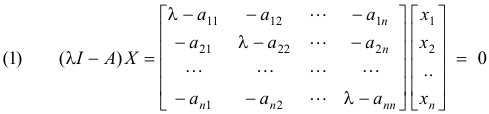
λIX - AX = 0
which is equivalent to
This is a homogeneous, linear system of n equations in n unknowns. It has non-trivial solutions if and only if the determinant of the coefficient matrix is equal to zero i.e. if
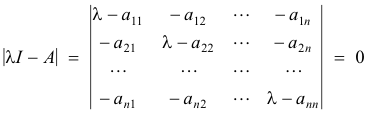
The expansion of this determinant yields a polynomial f(λ) of degree n in λ which is known as the characteristic polynomial of the transformation or of the matrix A. The equation f(λ) = 0 is called the characteristic equation of A and its roots λ1, λ2, .... ,λn are the eigenvalues of A.
Procedure for computing eigenvalues and eigenvectors.
1. Compute the eigenvalues λ1, λ2, .... ,λn by finding the roots of the characteristic equation

2. Solve the homogeneous linear system (1) above for each computed eigenvalue, λi. That is, for each λi, solve
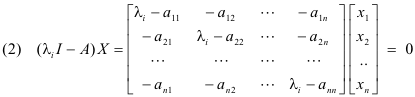
for X by reducing it to row canonical form with elementary row operations. The solution consists of a set of linearly independent vectors that spans the null space of the matrix λiI - A [or, equivalently, the solution space of (λiI - A )X = 0 ]. If λi is an r-fold root then the dimension of the null space will be between 1 and r.
The procedure used in step 2 corresponds to the general procedure for solving a homogeneous linear system AX = 0 where the matrix A of AX = 0 corresponds to the matrix (λiI - A ) in the equation (λiI - A )X = 0 .
As a review we give the general characteristics of the general solution of a homogeneous system AX = 0 and the concept of null space:
1. Complete solution of the homogeneous system AX = 0.
The complete solution of the linear system AX = 0 of m equations in n unknowns consists of the null space of A which can be given as all linear combinations of any set of linearly independent vectors which spans this null space. If the rank of A is r, there will be n-r linearly independent vectors u1, u2, .... ,un-r that span the null space of A. Thus the complete solution can be written as

where c1, c2, .... ,cn-r are arbitrary constants.
2. Null space of a matrix. The null space of a matrix A is that subspace consisting of all solution vectors X of the system of homogeneous equations AX = 0 i.e. it is the subspace of all vectors X which are imaged into the null element “0" by the matrix A (where A is viewed as a linear operator mapping points of n-space into itself). The dimension of this solution space of AX = 0 is called the nullity of A. If matrix A has nullity N , then AX = 0 has N linearly independent solutions X1, X2, ... ,XN such that every solution of AX = 0 is a linear combination of them and every such linear combination is a solution. A basis for the null space of A is any set of N linearly independent solutions of AX = 0. For an mxn matrix A of rank r and nullity N, N = n - r.
Eigenvector space associated with an eigenvector. The eigenvector space associated with the eigenvector λi is the null-space of λiI - A (or, equivalently, the solution space of (λiI - A) = 0 ). Synonym. invariant vector space associated with a characteristic root.
Synonyms.
Eigenvalue, characteristic root, latent root
Eigenvector, characteristic vector, invariant vector, latent vector
Eigenvector space, characteristic vector space, invariant vector space
Theorems.
1] Every n-square matrix has n eigenvalues. If these are discrete, there is one eigenvector corresponding to each eigenvalue and these eigenvectors are all linearly independent. If an eigenvalue occurs with multiplicity r, it may have from one to r linearly independent eigenvectors associated with it.
2] If λi is a simple characteristic root of an n-square matrix A , the dimension of the associated invariant vector space is 1. If λi is an r-fold characteristic root the dimension of the associated invariant space is ≤ r.
3] The characteristic roots of A and AT are the same.
4] The characteristic roots of
 and
and
 are the conjugates of the characteristic roots of A.
5] If an n-square matrix A has the characteristic roots λ1, λ2, .... ,λn and k is a scalar then the characteristic roots of kA are kλ1, kλ2, .... ,kλn.
6] If an n-square matrix A has the characteristic roots λ1, λ2, .... ,λn and k is a scalar then the characteristic roots of A - kI are λ1 - k, λ2 - k, λ3 - k .
7] If λ is a characteristic root of a nonsingular matrix A, then
 is a characteristic root of adj A.
References.
Ayres. Matrices (Schaum).
Jesus Christ and His Teachings
Way of enlightenment, wisdom, and understanding
America, a corrupt, depraved, shameless country
On integrity and the lack of it
The test of a person's Christianity is what he is
Ninety five percent of the problems that most people have come from personal foolishness
Liberalism, socialism and the modern welfare state
The desire to harm, a motivation for conduct
On Self-sufficient Country Living, Homesteading
Topically Arranged Proverbs, Precepts, Quotations. Common Sayings. Poor Richard's Almanac.
Theory on the Formation of Character
People are like radio tuners --- they pick out and listen to one wavelength and ignore the rest
Cause of Character Traits --- According to Aristotle
We are what we eat --- living under the discipline of a diet
Avoiding problems and trouble in life
Role of habit in formation of character
Personal attributes of the true Christian
What determines a person's character?
Love of God and love of virtue are closely united
Intellectual disparities among people and the power in good habits
Tools of Satan. Tactics and Tricks used by the Devil.
The Natural Way -- The Unnatural Way
Wisdom, Reason and Virtue are closely related
Knowledge is one thing, wisdom is another
My views on Christianity in America
The most important thing in life is understanding
We are all examples --- for good or for bad
Television --- spiritual poison
The Prime Mover that decides "What We Are"
Where do our outlooks, attitudes and values come from?
Sin is serious business. The punishment for it is real. Hell is real.
Self-imposed discipline and regimentation
Achieving happiness in life --- a matter of the right strategies
Self-control, self-restraint, self-discipline basic to so much in life