Website owner: James Miller
Congruence, Congruent Transformation, Symmetric matrices, Skew-symmetric matrices, Hermitian matrices, Skew-Hermitian matrices
Congruent Transformation. A transformation of the form B = PTAP of a matrix A by a non-singular matrix P, where PT is the transpose of P. B is said to be congruent to A.
Two n-square matrices A and B over some field F (real numbers, complex numbers, etc) are called congruent over F if there exists a nonsingular matrix P over F such that B = PTAP .
Since congruence is a special case of equivalence, congruent matrices have the same rank.
Theorem 1. Matrices A and B are congruent provided A can be reduced to B by a sequence of pairs of elementary operations, each pair consisting of an elementary row operation followed by the same elementary column operation.
Proof. Let P be expressed as a product of elementary column matrices:
P = K1K2 ... Kn
Then PT = KnT ... K2TK1T . Now because of the fact that an elementary row matrix is the transpose of the corresponding elementary column matrix
KnT ... K2TK1T = Hn ... H2H1
where Hi is the elementary row operation corresponding to the elementary column operation Ki.. Thus
PT = Hn ... H2H1
and
B = PTAP = Hn ... H2H1A K1K2 ... Kn
which is what we wanted to prove.
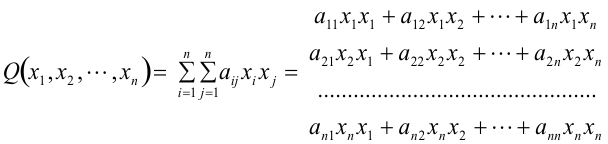
The concept of congruence has importance in connection with quadratic forms, specifically in regard to the question of what changes in coordinate system might reduce a particular quadratic form to its simplest form. Consider the quadratic form
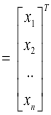
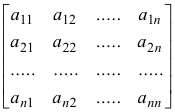
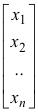
= XTAX
where A is the symmetric matrix of the coefficients of the form and X is the column vector of the variables. The elements aij are elements of some field F (real numbers, complex numbers, etc.). Let us consider what effect a change of basis given by X = PY has on the quadratic form. If X = PY then XT = YTPT and
XTAX = YTPTAPY
Thus the matrix A is transformed into a congruent matrix under this change of basis. Every symmetric matrix is congruent to a diagonal matrix, and hence every quadratic form can be changed to a form of type ∑kixi2 (its simplest canonical form) by a change of basis.
Symmetric matrices.
1] Every symmetric matrix A over a field F of rank r is congruent over F to a diagonal matrix whose first r diagonal elements are non-zero while all other elements are zero.
Real symmetric matrices.
1] A real symmetric matrix of rank r is congruent over the field of real numbers to a canonical matrix
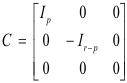
The integer p is called the index of the matrix and s = p - (r - p) is called the signature.
The index of a symmetric or Hermitian matrix is the number of positive elements when it is transformed to a diagonal matrix. The signature is the number of positive terms diminished by the number of negative terms and the total number of nonzero terms is the rank.
2] Two n-square real symmetric matrices are congruent over the real field if and only if they have the same rank and the same index or the same rank and the same signature.
Complex symmetric matrices.
1] Every n-square complex symmetric matrix of rank r is congruent over the field of complex numbers to a canonical matrix

2] Two n-square complex symmetric matrices are congruent over the field of complex numbers if and only if they have the same rank.
Skew-symmetric matrices.
1] Every matrix B = PTAP congruent to a skew-symmetric matrix A is also skew-symmetric.
2] Every n-square skew-symmetric matrix A over field F is congruent over F to a canonical matrix
B = diag(D1, D2, ....., Dt, 0, .... .0)
where
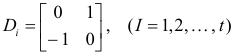
The rank of A is r = 2t.
3] Two n-square skew-symmetric matrices over a field F are congruent over F if and only if they have the same rank.
4] The set of all matrices of the type
B = diag(D1, D2, ....., Dt, 0, .... .0)
described above is a canonical set over congruence for n-square skew-symmetric matrices.
Hermitian matrices.
Hermitely congruent matrices. Two n-square Hermitian matrices A and B are called Hermitely congruent or conjunctive if there exits a nonsingular matrix P such that

1] Two n-square Hermitian matrices are conjunctive if and only if one can be obtained from the
other by a sequence of pairs of elementary operations, each pair consisting of a column operation
and the corresponding conjugate row operation. (For the three column operations Kij, Ki(k), Kij(k)
the conjugate row operations are
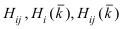 .) The proof is similar to that for Theorem
1 above.
.) The proof is similar to that for Theorem
1 above.
2] An Hermitian matrix A of rank r is conjunctive to a canonical matrix
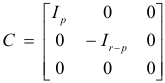
The integer p is called the index of the matrix and s = p - (r - p) is called the signature.
3] Two n-square Hermitian matrices are conjunctive if and only if they have the same rank and index or the same rank and signature.
Skew-Hermitian matrices.
1] Every matrix
 conjunctive to a skew-Hermitian matrix A is also skew-Hermitian.
2] Every n-square skew-Hermitian matrix A is conjunctive to a matrix
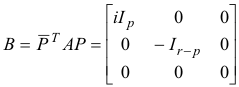
in which r is the rank of A and p is the index of -iA.
3] Two n-square skew-Hermitian matrices A and B are conjunctive if and only if they have the same rank while -iA and -iB have the same index.
References.
Ayres. Matrices (Schaum).
Jesus Christ and His Teachings
Way of enlightenment, wisdom, and understanding
America, a corrupt, depraved, shameless country
On integrity and the lack of it
The test of a person's Christianity is what he is
Ninety five percent of the problems that most people have come from personal foolishness
Liberalism, socialism and the modern welfare state
The desire to harm, a motivation for conduct
On Self-sufficient Country Living, Homesteading
Topically Arranged Proverbs, Precepts, Quotations. Common Sayings. Poor Richard's Almanac.
Theory on the Formation of Character
People are like radio tuners --- they pick out and listen to one wavelength and ignore the rest
Cause of Character Traits --- According to Aristotle
We are what we eat --- living under the discipline of a diet
Avoiding problems and trouble in life
Role of habit in formation of character
Personal attributes of the true Christian
What determines a person's character?
Love of God and love of virtue are closely united
Intellectual disparities among people and the power in good habits
Tools of Satan. Tactics and Tricks used by the Devil.
The Natural Way -- The Unnatural Way
Wisdom, Reason and Virtue are closely related
Knowledge is one thing, wisdom is another
My views on Christianity in America
The most important thing in life is understanding
We are all examples --- for good or for bad
Television --- spiritual poison
The Prime Mover that decides "What We Are"
Where do our outlooks, attitudes and values come from?
Sin is serious business. The punishment for it is real. Hell is real.
Self-imposed discipline and regimentation
Achieving happiness in life --- a matter of the right strategies
Self-control, self-restraint, self-discipline basic to so much in life