
Website owner: James Miller
THE EXPONENTIAL AND LOGARITHMIC FUNCTIONS, LOGARITHMIC DIFFERENTIATION
Exponents. The process of defining the meaning of an is a multi-step process.
Step 1. Define the meaning of the symbol an where a is any real number and n is a positive integer as follows:
a1 = a
a2 = a • a
a3 = a • a • a
.....
an = a • a • a .... to n factors
This gives us a meaning for an when the exponent n is a positive integer. The following laws are valid for an defined as above (m and n are positive integers):

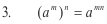

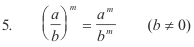
Next we want to give a meaning to such symbols as
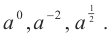
Our object will be to define these symbols in such a way that laws 1 through 5 will apply in all cases.
Step 2. Assign a meaning to a0. If we want Law 1 to hold so that

we must assign the value one to the symbol a0.
Def. a0 = 1.
Step 3. Assign a meaning to negative integral exponents. If we wish Law 1 to hold so that
am • a - m = am - m = a0 = 1 (m is an integer, a≠0)
we must agree that a - m = 1/am.
Def. a-m = 1/am where m is an integer.
Def. n-th root. If an = p, where n is a positive integer, we call a an n-th root of p, written
 There may be more than one real n-th root of p. For example since 22 = 4 and (-2)2 = 4, there
are two real square roots of 4, namely 2 and -2.
There may be more than one real n-th root of p. For example since 22 = 4 and (-2)2 = 4, there
are two real square roots of 4, namely 2 and -2.
Step 4. Assign a meaning to fractional exponents. If we wish Law 1 to hold so that

we must define the symbol a½ to stand for a square root of a. To avoid ambiguity we can define it to stand for the positive square root. In general, we define the symbol

to stand for the positive q-th root of a.
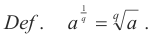
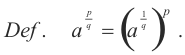
It follows from these definitions that
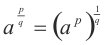
and that the above five laws are valid if m and n are either fractions or integers (i.e. if they are
rational numbers), provided a and b are positive numbers. If the exponent is irrational, the
power is defined to be the quantity approximated by using rational exponents which approximate
the irrational exponent; e.g. 3 with exponent
 denotes the limit of the sequence

Three important limits.
Theorem 1. If θ is in radians, then

Theorem 2. If θ is in radians, then

Theorem 3. The number e is given by

Logarithms to the base e are called natural logarithms. Loge x is often called log x (base omitted) or ln x.
Def. Exponential function. (1) The function ex.
(2) The function ax, where a is a positive constant. If a
 1, the function ax is the inverse of the
logarithmic function logax.
1, the function ax is the inverse of the
logarithmic function logax.
James & James. Mathematics Dictionary.
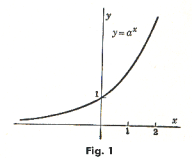
The exponential function y = ax is shown in Fig. 1. Its derivative is everywhere positive and increases with increasing values of x.
Def. Logarithmic function y = loga x (a > 1). The logarithmic function is defined as the inverse of the exponential function i.e. if
x = ay
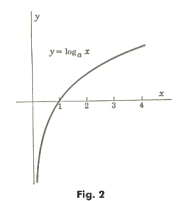
then
y = loga x .
See Fig. 2. Its graph is the same as that of y = ax with the axes interchanged. It is defined only for positive values of x.
The derivative of loga u.
Theorem.
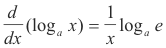
Proof. We wish to find the derivative of the function
y = loga x .
We proceed by applying the fundamental differentiation process. Starting at any point P on the curve and letting x increase by an amount Δx we have

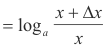
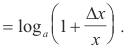
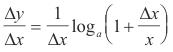
Let us now multiply numerator and denominator by x giving
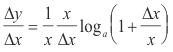
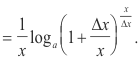
If now Δx
 0, the quantity
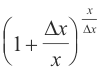
approaches the number e because it is of the form

with v approaching zero. We have then
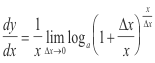

End of proof.
For the special case of natural logarithms where a = e this becomes
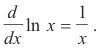
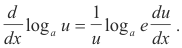
If we consider the function y = loga u where u is a differentiable function of x, its derivative with respect to x is given by
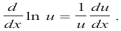
For the special case of natural logarithms this becomes
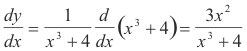
Example. Find dy/dx for
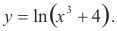
Solution.
The derivative of au.
Theorem.
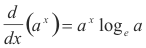
Proof. If
y = ax
then
x = loga y .
Taking the derivative with respect to y

or

= y loge a
= ax loge a
End of proof.
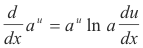
If u is a differentiable function of x we have
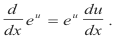
If a is the number e, we have
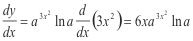
Example. Find dy/dx for

Solution.
Logarithmic differentiation. In obtaining the derivatives of certain kinds of functions, such as complicated products and quotients, and functions of the type uv, where u and v are both variable, it is often easier to take the logarithm before differentiating. This process is called logarithmic differentiation.
Example 1. Find dy/dx if

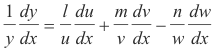
Solution. Taking logarithms of both sides
ln y = l ln u + m ln v - n ln w
Differentiating with respect to x
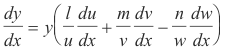
Solving for dy/dx
Example 2. Find dy/dx if
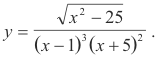
Solution. Taking logarithms of both sides

Differentiating with respect to x
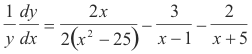
Solving for dy/dx
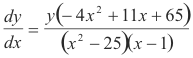
The derivative of uv. The derivative of a function of the form
y = uv,
where u and v are differentiable functions of x, can be found by the method of logarithmic differentiation.
Example. Differentiate y = (x + 1)x.
Solution. Taking the natural logarithm of each side, we obtain
ln y = x ln (x + 1).
Now differentiating this relation implicitly with respect to x we have
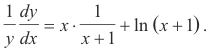
Solving for dy/dx we get
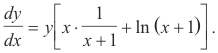
Note that neither the formula for the derivative of un nor the derivative for av applies to functions of this type.
Jesus Christ and His Teachings
Way of enlightenment, wisdom, and understanding
America, a corrupt, depraved, shameless country
On integrity and the lack of it
The test of a person's Christianity is what he is
Ninety five percent of the problems that most people have come from personal foolishness
Liberalism, socialism and the modern welfare state
The desire to harm, a motivation for conduct
On Self-sufficient Country Living, Homesteading
Topically Arranged Proverbs, Precepts, Quotations. Common Sayings. Poor Richard's Almanac.
Theory on the Formation of Character
People are like radio tuners --- they pick out and listen to one wavelength and ignore the rest
Cause of Character Traits --- According to Aristotle
We are what we eat --- living under the discipline of a diet
Avoiding problems and trouble in life
Role of habit in formation of character
Personal attributes of the true Christian
What determines a person's character?
Love of God and love of virtue are closely united
Intellectual disparities among people and the power in good habits
Tools of Satan. Tactics and Tricks used by the Devil.
The Natural Way -- The Unnatural Way
Wisdom, Reason and Virtue are closely related
Knowledge is one thing, wisdom is another
My views on Christianity in America
The most important thing in life is understanding
We are all examples --- for good or for bad
Television --- spiritual poison
The Prime Mover that decides "What We Are"
Where do our outlooks, attitudes and values come from?
Sin is serious business. The punishment for it is real. Hell is real.
Self-imposed discipline and regimentation
Achieving happiness in life --- a matter of the right strategies
Self-control, self-restraint, self-discipline basic to so much in life