Website owner: James Miller
RATIONAL EXPRESSION, RATIONAL ALGEBRAIC FRACTION, PARTIAL FRACTIONS, EXPRESSING A PROPER ALGEBRAIC FRACTION AS A SUM OF PARTIAL FRACTIONS
Definitions.
******************
Rational expression or function. An algebraic expression which involves no variable in an irreducible radical or under a fractional exponent.
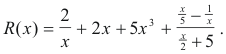
Examples. The expressions 2x2 + 1 and 2x + 1/x are rational. So is
However,
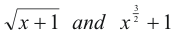
are not.
Theorem 1. Any rational expression can be expressed as a quotient g(x) / G(x) of two polynomials.
Rational algebraic fraction. A quotient g(x) / G(x) of two polynomials i.e.a fraction g(x) / G(x) in which the numerator and denominator are both polynomials.
Proper algebraic fraction. A rational algebraic fraction g(x) / G(x) in which the numerator is of lower degree than the denominator.
Examples.
1. x / (x3 + 2)
2. (x2 + 5x + 2) / (3x3 - 2x +1)
Improper algebraic fraction. A rational algebraic fraction g(x) / G(x) in which the numerator is not of lower degree than the denominator.
Example. (4x3 + 2x + 1) / (x2 + 5x + 2)
● An improper fraction can be expressed as the sum of a polynomial and a proper fraction by dividing the numerator by the denominator.
Fundamental Theorem of Algebra. If G(x) is a polynomial with real coefficients, then G(x) can be written as the product of linear and quadratic factors with real coefficients:
G(x) = c(x - α1)(x - α2) ... (x2 + b1x + c1) (x2 + b2x + c2) ...
where bi2- 4ci < 0.
● Any proper algebraic fraction g(x) / G(x) can thus be written in the form
g(x) / G(x) = g(x) / [ c(x - α1)(x - α2) ... (x2 + b1x + c1) (x2 + b2x + c2) ... ]
Partial fractions. A set of fractions whose algebraic sum is a given fraction. Any quotient of polynomials for which the numerator is of lesser degree than the denominator can be expressed as a sum of fractions of types

where n is a positive integer and all coefficients are real if all coefficients in the original polynomials were real. Indeed, partial fractions are usually understood to be fractions of these relatively simple types.
The term method of partial fractions is applied to the study of methods of finding these fractions and using them, particularly in integrating certain rational fractions.
James and James. Mathematics Dictionary
Procedure for expressing a proper algebraic fraction g(x) / G(x) as a sum of partial fractions of type

Let us consider the following cases:
Case 1. Distinct linear factors. To each linear factor x - a occurring once in the denominator of a proper fraction, there corresponds a single partial fraction of the form

where A is a constant to be determined. If, for example, the factors of the denominator of the given fraction g(x) / G(x) are all linear and distinct i.e.
G(x) = c(x - a)(x - b) ...
then
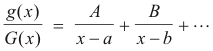
Case 2. Repeated linear factors. To each linear factor x - a occurring n times in the denominator of a proper fraction, there corresponds a sum of n partial fractions of the form
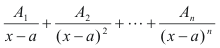
where the A’s are constants to be determined. Suppose, for example, that the denominator G(x) can be factored into real linear factors, one or more repeated i.e.
G(x) = c(x - a)(x - b) ...(x - q)m ...
Then

Case 3. Distinct quadratic factors. To each irreducible quadratic factor x2 + bx + c occurring once in the denominator of a proper fraction, there corresponds a single partial fraction of the form

where A and B are constants to be determined. If, for example, the denominator G(x) can be factored into irreducible quadratic factors, all different i.e.
G(x) = c(x2 + b1x + c1)(x2 + b2x + c2) ...
then

Case 4. Repeated quadratic factors. To each irreducible quadratic factor x2 + bx + c occurring n times in the denominator of a proper fraction, there corresponds a sum of n partial fractions of the form

where the A’s and B’s are constants to be determined. If, for example, the denominator G(x) can be factored into irreducible quadratic factors, one or more repeated i.e.
G(x) = c(x2 + b1x + c1)(x2 + b2x + c2) ... (x2 + p1x + q1)m ...
then


In summary. If the denominator G(x) can be factored into a mixture of linear and irreducible quadratic factors, some of which may be repeated i.e.
G(x) = c(x - a)(x - b) ...(x - q)m ...(x2 + b1x + c1) ... (x2 + p1x + q1)m ...
then


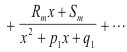
General methods for evaluating coefficients. Let

1. Method of undetermined coefficients.. Multiply both sides of equation by D(x) to clear fractions. Then collect like terms, equate the powers of x, and solve the resulting simultaneous equations for the unknown coefficients.
2. Substitution method. Multiply both sides of equation by D(x) to clear fractions. Then let x assume certain convenient values (x = 1, 0, -1, ...) and solve the resulting equations for the unknown coefficients.
Example.
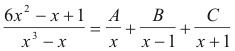
Clearing of fractions,
(1) 6x2 - x + 1 = A(x - 1)(x + 1) + Bx(x + 1) + Cx(x - 1)
Substitution method. Let x = 0. Then A = -1. Letting x = 1, B = 3. Letting x = -1, C = 4. Then
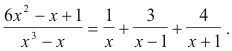
Method of undetermined coefficients. Rewriting (1)
6x2 - x + 1 = (A + B + C)x2 + (B - C)x - A
Equating coefficients of like powers of x
A + B + C = 6
B - C = -1
-A = 1
Solving this system of equations,
A = -1, B = 3, C= 4.
References.
James and James. Mathematics Dictionary
Ayres. Differential and Integral Calculus.
Osgood. Advanced Calculus
Eshbach. Handbook of Engineering Fundamentals.
CRC Standard Mathematical Tables.
Jesus Christ and His Teachings
Way of enlightenment, wisdom, and understanding
America, a corrupt, depraved, shameless country
On integrity and the lack of it
The test of a person's Christianity is what he is
Ninety five percent of the problems that most people have come from personal foolishness
Liberalism, socialism and the modern welfare state
The desire to harm, a motivation for conduct
On Self-sufficient Country Living, Homesteading
Topically Arranged Proverbs, Precepts, Quotations. Common Sayings. Poor Richard's Almanac.
Theory on the Formation of Character
People are like radio tuners --- they pick out and listen to one wavelength and ignore the rest
Cause of Character Traits --- According to Aristotle
We are what we eat --- living under the discipline of a diet
Avoiding problems and trouble in life
Role of habit in formation of character
Personal attributes of the true Christian
What determines a person's character?
Love of God and love of virtue are closely united
Intellectual disparities among people and the power in good habits
Tools of Satan. Tactics and Tricks used by the Devil.
The Natural Way -- The Unnatural Way
Wisdom, Reason and Virtue are closely related
Knowledge is one thing, wisdom is another
My views on Christianity in America
The most important thing in life is understanding
We are all examples --- for good or for bad
Television --- spiritual poison
The Prime Mover that decides "What We Are"
Where do our outlooks, attitudes and values come from?
Sin is serious business. The punishment for it is real. Hell is real.
Self-imposed discipline and regimentation
Achieving happiness in life --- a matter of the right strategies
Self-control, self-restraint, self-discipline basic to so much in life