
Website owner: James Miller
Derivation of the Gauss-Weingarten equations
Problem. Derive the Gauss-Weingarten equations:




Derivation. Before giving the derivation of the equations we first present some notation and a theorem that we shall need.
Determinant notation. We will use the notation
|A B C|
to denote the determinant

whose columns are the components of the vectors
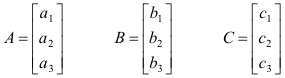
Theorem 1. If A, B, C are three linearly independent vectors in three-dimensional space and X is any other vector in 3-space then X can be expressed as a linear combination of vectors A, B and C i.e.
X = αA + βB + γC .
Furthermore, the vectors X, A, B, C are related by the following identity:
1) |A B C| X = |B C X| A + |C A X| B + |A B X| C
Proof. From a magic hat we pull the following set of three equations and assert them to be true.
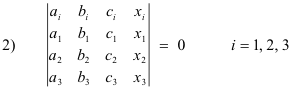
Their validity follows from the fact for each equation, i = 1, 2, 3, the first row of the determinant is identical to one of the last three rows.
Let us now expand the determinant by the method of minors using the elements of the first row. We get
2) |B C X| ai - |A C X| bi + |A B X| ci - |A B C| xi = 0 i = 1, 2, 3
which is equivalent to
3) |A B C| X = |B C X| A + |C A X| B + |A B X| C
Thus since 1) is true and 3) is equivalent to 1), 3) is true.
End of Proof.
Corollary 1. If A, B, C are three linearly independent vectors in three-dimensional space and X is any other vector in 3-space then the vectors X, A, B, C are related by the following identity:

This follows from the fact that for a determinant |A B C|

Derivation of Gauss equations. Let S be a simple surface element of class
 defined
by the one-to-one mapping
defined
by the one-to-one mapping
x = x(u, v)
y = y(u, v)
z = z(u, v)
of a region R of the uv-plane into xyz-space. Let


be the position vector to point P on the surface.
Let us now take the vectors
 as the basis for a coordinate system at point P on surface S
and express
as the basis for a coordinate system at point P on surface S
and express
 as linear combinations of
 . Because of the identity

we can write 4) as

We substitute into 5) using
 and obtain

Now
 is a vector normal to the surface at point P with a magnitude of
 . Thus

and
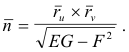
Let
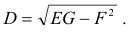
Substituting D into 6) we get

Substituting

into the first two terms we get

Now successively substituting into 7)
 for
for
 we get
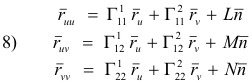
where



Expanding these coefficients and expressing them in terms of the fundamental coefficients E, F, G we obtain



In deriving 10) we employ the following



which are the Christoffel symbols of the first kind. They are easily verified by taking the indicated partial derivatives of

Derivation of Weingarten equations. Taking the vectors
 as the basis for a
coordinate system at point P on surface S we can express
as the basis for a
coordinate system at point P on surface S we can express
 as linear combinations of
 as
as


Because
 and
and
 lie in the tangent plane, α3 = β3 = 0, and the equations are of the form


Let us now compute the values of the coefficients α1, α2, β1, β2. To that end, take the dot product
of both sides of these equations, with first
 and then
 as follows:
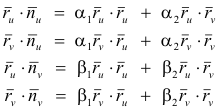
These equations are equivalent to the following:
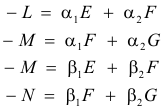
Solving the first two of these equations for α1, α2 and the second two for β1, β2 gives


Jesus Christ and His Teachings
Way of enlightenment, wisdom, and understanding
America, a corrupt, depraved, shameless country
On integrity and the lack of it
The test of a person's Christianity is what he is
Ninety five percent of the problems that most people have come from personal foolishness
Liberalism, socialism and the modern welfare state
The desire to harm, a motivation for conduct
On Self-sufficient Country Living, Homesteading
Topically Arranged Proverbs, Precepts, Quotations. Common Sayings. Poor Richard's Almanac.
Theory on the Formation of Character
People are like radio tuners --- they pick out and listen to one wavelength and ignore the rest
Cause of Character Traits --- According to Aristotle
We are what we eat --- living under the discipline of a diet
Avoiding problems and trouble in life
Role of habit in formation of character
Personal attributes of the true Christian
What determines a person's character?
Love of God and love of virtue are closely united
Intellectual disparities among people and the power in good habits
Tools of Satan. Tactics and Tricks used by the Devil.
The Natural Way -- The Unnatural Way
Wisdom, Reason and Virtue are closely related
Knowledge is one thing, wisdom is another
My views on Christianity in America
The most important thing in life is understanding
We are all examples --- for good or for bad
Television --- spiritual poison
The Prime Mover that decides "What We Are"
Where do our outlooks, attitudes and values come from?
Sin is serious business. The punishment for it is real. Hell is real.
Self-imposed discipline and regimentation
Achieving happiness in life --- a matter of the right strategies
Self-control, self-restraint, self-discipline basic to so much in life
Website owner: James Miller