Website owner: James Miller
DUPIN INDICATRIX, ASYMPTOTIC DIRECTIONS AND LINES
Dupin indicatrix of a surface at a point. Let P be some point on a surface S. Consider an xy-coordinate system where the x-axis represents the direction of minimum curvature k1 and the y-axis represents the direction of maximum curvature k2 at point P. The Dupin indicatrix of the surface at point P depends on the value of the total (Gaussian) curvature K = k1k2 at point P as follows:
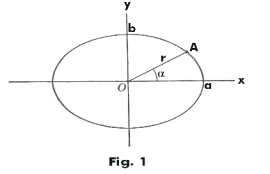
K > 0. The Dupin indicatrix is the ellipse
|k1| x2 + |k2| y2 = 1
See Fig. 1.
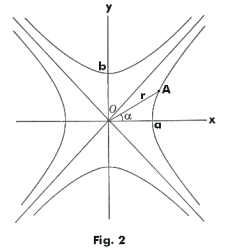
K < 0. The Dupin indicatrix is a set of conjugate hyperbolas
k1 x2 + k2 y2 = 1
k1 x2 + k2 y2 = -1
See Fig. 2.
K = 0. The Dupin indicatrix is a set of parallel lines corresponding to one of the forms
x2 = |1/k1| or y2 = |1/k2|
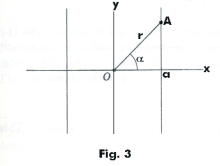
See Fig. 3.
We will now examine these three cases in detail.
Case 1. K > 0. k1 and k2 have the same sign, the surface at point P is bowl shaped, and point P is an elliptic point. Let us suppose that k1 and k2 are both positive. Then the Dupin indicatrix at point P is the ellipse
1) k1x2 + k2y2 = 1
shown in Fig. 1. Let us compute the distance r from the origin to point A. The equation of line OA is
2) y = x tan α .
We find the coordinates (x, y) of point A by solving equations 1) and 2) simultaneously. If we substitute 2) into 1) we obtain
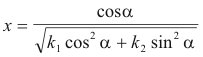
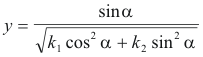
The distance r is then given by

and since
k1(α) = k1 cos2 α + k2 sin2 α ,
where kn(α) is the normal curvature at point P in the direction α , we have
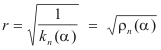
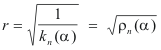
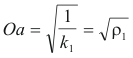
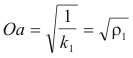
where ρn(α) is the radius of normal curvature in the direction α. The x and y intercepts Oa and Ob are
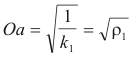
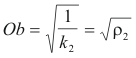
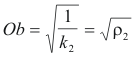
where ρ1 and ρ2 are the radii of normal curvature corresponding to k1 and k2.
Case 2. K < 0. k1 and k2 have opposite signs, the surface at point P is saddle shaped, and point P is a hyperbolic point. The Dupin indicatrix is a set of conjugate hyperbolas
k1 x2 + k2 y2 = 1
k1 x2 + k2 y2 = -1
shown in Fig. 2. As in Case 1, and by the same type analysis, the values of r, Oa and Ob are
The two asymptotes of the hyperbolas are lines representing directions at which kn(α) = 0. As the angle α increases and passes over an asymptote a passage occurs from one hyperbola to the other along with a change in sign of kn(α).
Case 3. K = 0. Either k1 = 0 or k2 = 0, the surface at point P is a parabolic cylinder, and point P is a parabolic point. If k1 = 0 the Dupin indicatrix is a set of parallel lines corresponding to the equation
y2 = |1/k2| .
If k2 = 0 the Dupin indicatrix is a set of parallel lines corresponding to the equation
x2 = |1/k1| .
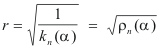
As in the other cases, and by the same type analysis, the values of r, and Oa are
Overview. The above three cases represent the different locii to which the equation
k1 x2 + k2 y2 = 1
can give rise depending on the various possible combinations of signs and values of the constants k1 and k2. The Dupin indicatrix of a surface S at a point P is a device for gaining insight into the character of the surface near P. The curve of intersection of S and a nearby plane parallel to the tangent plane at P is approximately similar to the Dupin indicatrix. In the case of a hyperbolic point the surface S lies on both sides of the tangent plane so we need to intersect the surface with two planes close to the tangent plane, parallel to it, one on each side. If S lies entirely on one side of the tangent plane intersection by a single plane is adequate.
Asymptotic directions. A direction at a point P on a surface for which
1) L du2 + 2M du dv + N dv2 = 0
is called an asymptotic direction. Because the denominator of

is positive definite, the asymptotic directions are also the directions in which kn = 0. At an elliptic point there are no asymptotic directions, at a hyperbolic point there are two distinct asymptotic directions, at a parabolic point there is one asymptotic direction and at a planar point every direction is asymptotic.
Asymptotic lines. A curve on a surface which is tangent to an asymptotic direction at every point is called an asymptotic line. Thus a curve on a surface element is an asymptotic line if and only if at each point of the curve the direction of the tangent to the curve satisfies 1). At a hyperbolic point equation 1) has two real distinct factors of the form Adu + Bdv = 0 which can be regarded as first order differential equations of the asymptotic lines.
Theorem 1. The u and v coordinate curves on a surface element are asymptotic lines if and only if at each point L = N = 0.
References.
1. Graustein. Differential Geometry.
2. Lipschutz. Differential Geometry
3. James/James. Mathematics Dictionary.
4. Struik. Lectures on Classical Differential Geometry.
Jesus Christ and His Teachings
Way of enlightenment, wisdom, and understanding
America, a corrupt, depraved, shameless country
On integrity and the lack of it
The test of a person's Christianity is what he is
Ninety five percent of the problems that most people have come from personal foolishness
Liberalism, socialism and the modern welfare state
The desire to harm, a motivation for conduct
On Self-sufficient Country Living, Homesteading
Topically Arranged Proverbs, Precepts, Quotations. Common Sayings. Poor Richard's Almanac.
Theory on the Formation of Character
People are like radio tuners --- they pick out and listen to one wavelength and ignore the rest
Cause of Character Traits --- According to Aristotle
We are what we eat --- living under the discipline of a diet
Avoiding problems and trouble in life
Role of habit in formation of character
Personal attributes of the true Christian
What determines a person's character?
Love of God and love of virtue are closely united
Intellectual disparities among people and the power in good habits
Tools of Satan. Tactics and Tricks used by the Devil.
The Natural Way -- The Unnatural Way
Wisdom, Reason and Virtue are closely related
Knowledge is one thing, wisdom is another
My views on Christianity in America
The most important thing in life is understanding
We are all examples --- for good or for bad
Television --- spiritual poison
The Prime Mover that decides "What We Are"
Where do our outlooks, attitudes and values come from?
Sin is serious business. The punishment for it is real. Hell is real.
Self-imposed discipline and regimentation
Achieving happiness in life --- a matter of the right strategies
Self-control, self-restraint, self-discipline basic to so much in life