Website owner: James Miller
Products, quotients and roots of complex numbers in polar form. De Moivre’s theorem. Roots of unity
Polar representation of a complex number. The polar representation of the complex number
z = x + iy
is
z = x + iy = r (cos θ + i sin θ)
where
x = r cos θ
y = r sin θ

θ = arctan (y/x)
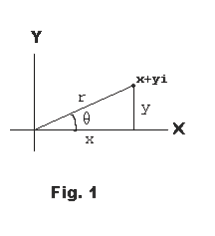
See Figure 1. The radius vector r is called the modulus or absolute value of the complex number and the polar angle θ is called the amplitude or argument of the number. The argument θ of a complex number z is often denoted by arg z. The abbreviation cis θ is sometimes used for cos θ + i sin θ. In polar coordinates a point P is often specified by the number pair (r, θ).
Product of two complex numbers in polar form. The product z1z2 of the two complex numbers
z1 = r1 (cos θ1 + i sin θ1)
and
z2 = r2 (cos θ2 + i sin θ2)
is
1) z1z2 = r1r2[cos (θ1 + θ2) + i sin (θ1 + θ2)] ,
a result which can be easily obtained by utilizing the trigonometric identities
sin(A
 B) = sin A cos B
 cos A sin B
cos(A
 B) = cos A cos B
 sin A sin B .
Quotient of two complex numbers in polar form. The quotient z1/z2 of the two complex numbers
z1 = r1 (cos θ1 + i sin θ1)
and
z2 = r2 (cos θ2 + i sin θ2)
is
2) z1/z2 = ( r1/r2) [cos (θ1 - θ2) + i sin (θ1 - θ2)]
De Moivre’s Theorem. For any complex number z = r( cos θ + i sin θ )
3) zn = [ r(cos θ + i sin θ)]n = rn (cos nθ + i sin n)
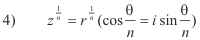
This formula holds for every real value of the exponent n. For example, if the exponent is a fraction 1/n, we get
Rules of arguments. If
z1 = r1 (cos θ1 + i sin θ1)
z2 = r2 (cos θ2 + i sin θ2)
w = za
where a is a real number, then by 1), 2) and 3 ) above
1] arg (z1z2) = arg z1 + arg z2
2] arg (z1/z2) = arg z1 - arg z2
3] arg w = a arg z
Def. N-th root of a number. Let n be a positive integer. If an = b, then a is said to be the n-th root of b.
Roots of complex numbers in polar form. The n distinct n-th roots of the complex number
z = r( cos θ + i sin θ)
can be found by substituting successively k = 0, 1, 2, ... , (n-1) in the formula

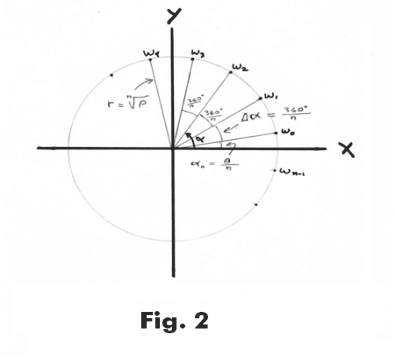
The n roots are equally spaced around the circumference of a circle in the complex plane. See Figure 2. If the complex number for which we are computing the n n-th roots is z = ρ( cos θ + i sin θ) the radius of the circle will be

and the first root w0 corresponding to k = 0 will be at an amplitude of α = θ/n. This root will be followed by the n-1 remaining roots at equal distances apart. The angular amplitude between each root is Δα = 360o/n.
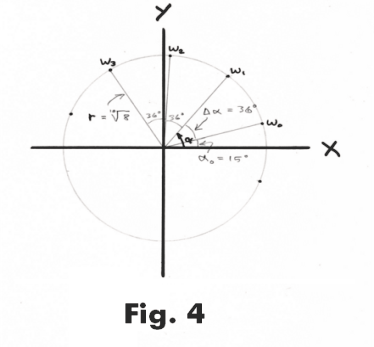
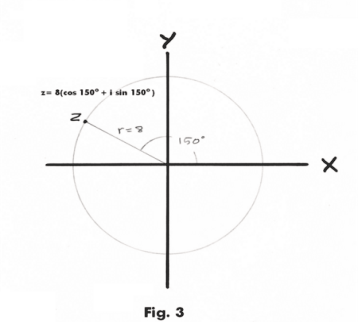
Example. Suppose we wish to compute the ten 10-th roots of z = 8(cos 150o + i sin 150o) shown in Fig. 3. The ten roots w0, w1, .... , w9 would be spaced evenly around a circle as shown in Fig. 4. The first root, w0, would be at an amplitude of α = 150/10 = 15o. The rest of the roots would be spaced at Δα = 360/10 = 36o intervals.
Roots of unity. The n n-th roots of 1 are obtained from 5) above by letting r = 1 and θ = 0. They are
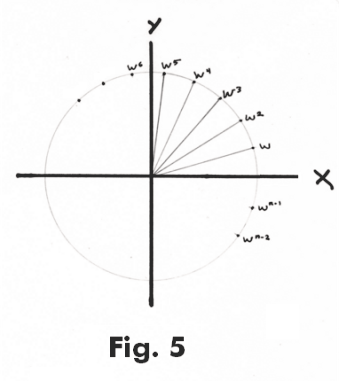
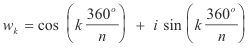
for k = 0, 1, 2, ... , (n-1)
Let us denote the root corresponding to k = 1 by w. This root w is then given by
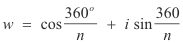
The n n-th roots of 1 then correspond to powers of w:
w, w2, w3, ... ,wn
where wn = 1
The roots are equally spaced around the circumference of a unit circle in the complex plane. See Figure 5.
Primitive roots of unity. Of the n n-th roots of 1 some of the roots may be m-th roots of 1 where m is some integer less than n. For example, the 6 sixth roots of 1 are
r1 = w
r2 = w2
r3 = w3
r4 = w4
r5 = w5
r6 = w6 = 1
Of these, r3 = w3 and r6 = w6 are square roots of 1 and r2 = w2, r4 = w4 and r6 = w6 are
cube roots of 1. The primitive roots of 1 are those roots which are not m-th roots of 1 for some 0
< m < n. Thus in the example just given the roots r1 = w and r5 = w5 are primitive roots of
1. In other words, of the n n-th roots of 1, a particular n-th root r is a primitive root if and only if
rm
 1 for any integer m less than n.
Theorem Let w, w2, w3, ... ,wn be the n n-th roots of 1. Let m be any integer 0 < m < n and let d be the greatest common divisor (m,n) of m and n. If d > 1 then , wm is an n/d-th root of 1.
Example. Let m = 3 and n = 6. Then d = (m,n) = (3,6) = 3 and n/d = 2. Thus w3 is a square root of 1.
Corollary. The primitive n-th roots of 1 are those and only those n-th roots w, w2, w3, ... ,wn of 1 whose exponents are relatively prime to n.
Roots of a complex number in terms of the roots of unity. Let
z = a + bi = r( cos θ + i sin θ )
and
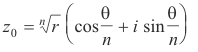
Then the n n-th roots of z are
z0, wz0, w2z0, ... ,w k-1z0
where

References.
James & James. Mathematics Dictionary.
Brink. A First Year of College Mathematics.
Spiegel. College Algebra.
Hauser. Complex Variables with Physical Applications.
Jesus Christ and His Teachings
Way of enlightenment, wisdom, and understanding
America, a corrupt, depraved, shameless country
On integrity and the lack of it
The test of a person's Christianity is what he is
Ninety five percent of the problems that most people have come from personal foolishness
Liberalism, socialism and the modern welfare state
The desire to harm, a motivation for conduct
On Self-sufficient Country Living, Homesteading
Topically Arranged Proverbs, Precepts, Quotations. Common Sayings. Poor Richard's Almanac.
Theory on the Formation of Character
People are like radio tuners --- they pick out and listen to one wavelength and ignore the rest
Cause of Character Traits --- According to Aristotle
We are what we eat --- living under the discipline of a diet
Avoiding problems and trouble in life
Role of habit in formation of character
Personal attributes of the true Christian
What determines a person's character?
Love of God and love of virtue are closely united
Intellectual disparities among people and the power in good habits
Tools of Satan. Tactics and Tricks used by the Devil.
The Natural Way -- The Unnatural Way
Wisdom, Reason and Virtue are closely related
Knowledge is one thing, wisdom is another
My views on Christianity in America
The most important thing in life is understanding
We are all examples --- for good or for bad
Television --- spiritual poison
The Prime Mover that decides "What We Are"
Where do our outlooks, attitudes and values come from?
Sin is serious business. The punishment for it is real. Hell is real.
Self-imposed discipline and regimentation
Achieving happiness in life --- a matter of the right strategies
Self-control, self-restraint, self-discipline basic to so much in life