Website owner: James Miller
Ways of viewing a non-singular linear transformation Y = AX
There are different ways of viewing a non-singular linear transformation Y = AX.
1. As a change of basis. Y = AX can be viewed as a change of basis – a change to a basis whose basis vectors correspond to the columns of matrix A. In two and three dimensional space this corresponds to a change to a different coordinate system, a rotated coordinate system (the transformation Y = AX involves no translation).
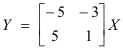
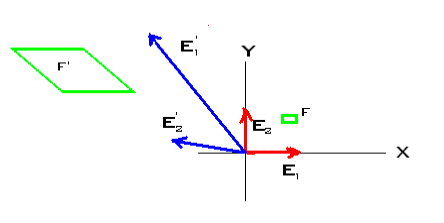
2. As a mapping of points of n-dimensional space into itself. We view the matrix A as an operator, a black box with an input and an output. You input a point and it outputs another point. In this way, matrix A maps the points of some figure in space into some other figure in space. A device for understanding how matrix A maps points is to observe what it maps its basis vectors, the elementary unit vectors E1, E2, .... , En, into. In fact, the elementary unit vectors E1, E2, .... , En will map into the column vectors of A. For example, consider the mapping
in 2-space. The elementary unit vector

maps into

and the elementary unit vector

maps into
 .
.
We can then form an idea of what it would map something like a rectangle into. If it maps E1 into E1' and E2 into E2' then it will map the vector
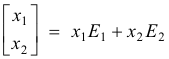
into the vector x1 E1' + x2 E2'. See figure. Area F is mapped into area F’.
3. As a linear point transformation consisting of : 1) a change of basis to the eigenbasis of matrix A 2) a point transformation effected by a diagonal matrix in the eigenvector system 3) a change back to the original E-basis –- all represented by Y = BDB -1 X .
If the eigenvalues of A are distinct the linear transformation Y = AX can written as Y = BDB -1 X where D is a diagonal matrix whose diagonal elements consist of the eigenvalues of A and B is a matrix whose columns consist of the corresponding normalized eigenvectors of A. This representation of matrix A as equivalent to the product BDB -1 implies a three step sequence:
(1) A change of basis from the usual coordinate system (E-basis) to the Eigenvector Coordinate System (the canonical coordinate system where the actual point transformation is performed – and called the eigenbasis of A, a basis consisting of the eigenvectors of A).
(2) A linear point transformation effected by the diagonal matrix D in the Eigenvector Coordinate System. The effect of this transformation is simply stretching (or compressing) effects directed in the directions of the different coordinate system axes with magnitudes given by the eigenvalues.
(3) A change back to to the original E-basis.
4. As a linear point transformation consisting of : 1) a rotation in an orthonormal basis 2) a linear point transformation effected by a diagonal matrix consisting of stretching / compression in mutually orthogonal directions 3) another rotation in an orthonormal basis.
Let Y = AX be a non-singular linear transformation. Let λ1, λ2, .... , λn be the n eigenvectors of the matrix (AAT) -1 and B be a matrix whose columns consist of the corresponding normalized eigenvectors of (AAT) -1 . Let
 .
.
Let
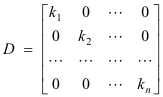
and
C = A -1B D
Then A can be factored as:
A = BDCT
Matrices B and CT are both orthonormal matrices effecting “rotations” in n-dimensional space and matrix D effects stretching / compression in mutually orthogonal directions in n-space.
Jesus Christ and His Teachings
Way of enlightenment, wisdom, and understanding
America, a corrupt, depraved, shameless country
On integrity and the lack of it
The test of a person's Christianity is what he is
Ninety five percent of the problems that most people have come from personal foolishness
Liberalism, socialism and the modern welfare state
The desire to harm, a motivation for conduct
On Self-sufficient Country Living, Homesteading
Topically Arranged Proverbs, Precepts, Quotations. Common Sayings. Poor Richard's Almanac.
Theory on the Formation of Character
People are like radio tuners --- they pick out and listen to one wavelength and ignore the rest
Cause of Character Traits --- According to Aristotle
We are what we eat --- living under the discipline of a diet
Avoiding problems and trouble in life
Role of habit in formation of character
Personal attributes of the true Christian
What determines a person's character?
Love of God and love of virtue are closely united
Intellectual disparities among people and the power in good habits
Tools of Satan. Tactics and Tricks used by the Devil.
The Natural Way -- The Unnatural Way
Wisdom, Reason and Virtue are closely related
Knowledge is one thing, wisdom is another
My views on Christianity in America
The most important thing in life is understanding
We are all examples --- for good or for bad
Television --- spiritual poison
The Prime Mover that decides "What We Are"
Where do our outlooks, attitudes and values come from?
Sin is serious business. The punishment for it is real. Hell is real.
Self-imposed discipline and regimentation
Achieving happiness in life --- a matter of the right strategies
Self-control, self-restraint, self-discipline basic to so much in life