Website owner: James Miller
Determinant, Minor, Cofactor, Evaluation of a determinant by cofactors
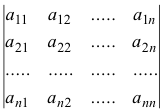
Determinant. A square array of quantities, called elements, symbolizing the sum of certain products of these elements. The symbol
denotes a determinant of order n. It is an abbreviation for the algebraic sum of all possible products

where each product of n factors contains one and only one element from each row and one and only one element from each column. There will be n! such products. Each product has a plus or minus sign attached to it according as the column indices form an even or odd permutation when the row indices are in natural order (i.e. 1, 2, 3, ... ) .For example, the term a13a21a34a42 of the expansion of a determinant of order four has the column indices in order (3,1,4,2) . This term should have a negative sign attached, since three successive interchanges will change the column indices to (1,3,4,2), (1,3,2,4) and (1,2,3,4), the last being in natural order.
Properties of determinants.
1. If all the elements of a column (or row) are zero, the value of the determinant is zero.
2. If each of the elements in a row (or column) of a determinant is multiplied by the same number p, the value of the determinant is multiplied by p.
3. If two columns (or rows) are identical, the value of the determinant is zero.
4. Interchanging any two rows (or columns) reverses the sign of the determinant.
5. The value of a determinant is unaltered when all the corresponding rows and columns are interchanged i.e. for a square matrix A,

Thus any theorem proved true for rows holds for columns, and conversely.
Example.
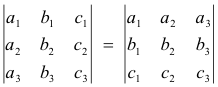
6. If each element of a row (or column) of a determinant is expressed as the sum of two (or more) terms, the determinant can be expressed as the sum of two (or more) determinants.
Example.
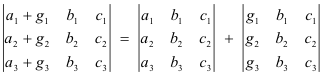
7. If to each element of a row (or column) of a determinant is added m times the corresponding element of another row (or column) the value of the determinant is not changed.
Minor of an element in a determinant. The determinant, of next lower order, obtained by striking out the row and column in which the element lies.
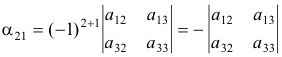
Cofactor of an element in a determinant. Denote the minor of element aij of the i-th row and j-th column of a determinant |A| by |Mij |. The cofactor of the element aij is given as the signed minor (-1)i+j |Mij | i.e. it is the minor, taken with a positive or negative sign, according as the sum of the column number and the row number is even or odd.
Example. Let
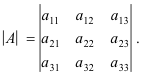
Then the minor of element a21 is
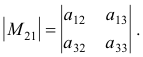
The cofactor of element a21 is
Evaluation of a determinant by minors. The value of a determinant of order n is equal to the sum of the products formed by multiplying each element of any selected row (or column) by its cofactor. The value of a determinant of order 1 is the value of the single element of the determinant.
Example. Let
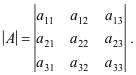
Then

where a11, a12 and a13 are the cofactors of a11, a12 and a13.
*************************************
Minors and cofactors of matrices
*************************************
Minor of an element of a square matrix. The minor of an element aij of an n-square matrix is the determinant of the (n-1)-square matrix obtained by striking out the row and column in which the element lies.
Cofactor of an element in a square matrix. Denote the minor of element aij of the i-th row and j-th column of a matrix A by |Mij | . The cofactor of the element aij is given as the signed minor (-1)i+j |Mij | i.e. it is the minor, taken with a positive or negative sign, according as the sum of the column number and the row number is even or odd.
Jesus Christ and His Teachings
Way of enlightenment, wisdom, and understanding
America, a corrupt, depraved, shameless country
On integrity and the lack of it
The test of a person's Christianity is what he is
Ninety five percent of the problems that most people have come from personal foolishness
Liberalism, socialism and the modern welfare state
The desire to harm, a motivation for conduct
On Self-sufficient Country Living, Homesteading
Topically Arranged Proverbs, Precepts, Quotations. Common Sayings. Poor Richard's Almanac.
Theory on the Formation of Character
People are like radio tuners --- they pick out and listen to one wavelength and ignore the rest
Cause of Character Traits --- According to Aristotle
We are what we eat --- living under the discipline of a diet
Avoiding problems and trouble in life
Role of habit in formation of character
Personal attributes of the true Christian
What determines a person's character?
Love of God and love of virtue are closely united
Intellectual disparities among people and the power in good habits
Tools of Satan. Tactics and Tricks used by the Devil.
The Natural Way -- The Unnatural Way
Wisdom, Reason and Virtue are closely related
Knowledge is one thing, wisdom is another
My views on Christianity in America
The most important thing in life is understanding
We are all examples --- for good or for bad
Television --- spiritual poison
The Prime Mover that decides "What We Are"
Where do our outlooks, attitudes and values come from?
Sin is serious business. The punishment for it is real. Hell is real.
Self-imposed discipline and regimentation
Achieving happiness in life --- a matter of the right strategies
Self-control, self-restraint, self-discipline basic to so much in life