Website owner: James Miller
Types of matrices — triangular, diagonal, scalar, identity, symmetric, skew-symmetric, periodic, nilpotent
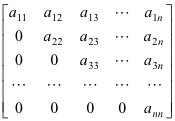
Upper triangular matrix. A square matrix in which all the elements below the diagonal are zero i.e. a matrix of type:
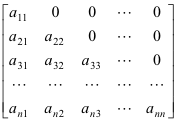
Lower triangular matrix. A square matrix in which all the elements above the diagonal are zero i.e. a matrix of type
Diagonal matrix. A square matrix in which all of the elements are zero except for the diagonal elements i.e. a matrix of type
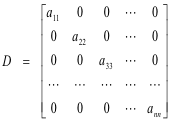
It is often written as D = diag(a11, a22, a33, ... , ann)
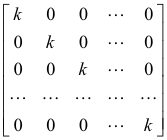
Scalar matrix. A diagonal matrix in which all of the diagonal elements are equal to some constant “k” i.e. a matrix of type
Identity matrix. A diagonal matrix in which all of the diagonal elements are equal to “1" i.e. a matrix of type
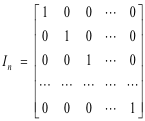
An identity matrix of order nxn is denoted by In .
Transpose of a matrix. The matrix resulting from interchanging the rows and columns in the given matrix. The transpose of

is

The first row of A becomes the first column of AT, the second row of A becomes the second column of AT, etc.. It corresponds to a “flip”of the matrix about the diagonal running down from the upper left corner.
Symmetric matrix. A square matrix in which corresponding elements with respect to the diagonal are equal; a matrix in which aij = aji where aij is the element in the i-th row and j-th column; a matrix which is equal to its transpose; a square matrix in which a flip about the diagonal leaves it unchanged. Example:
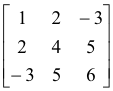
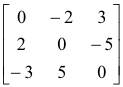
Skew-symmetric matrix. A square matrix in which corresponding elements with respect to the diagonal are negatives of each other; a matrix in which aij = -aji where aij is the element in the i-th row and j-th column; a matrix which is equal to the negative of its transpose. The diagonal elements are always zeros. Example:
Direct Sum. Let A1, A2, ... ,As be square matrices of respective orders m1, m2, ... ,ms .
The generalization
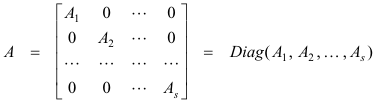
of the diagonal matrix is called the direct sum of the Ai.
Inverse of a matrix. If A and B are square matrices such that AB = BA = I where I is the identity matrix , then B is called the inverse of A and we write B = A-1 . The matrix B also has A as an inverse and we can write A = B-1 .
Commutative and anti-commutative matrices. If A and B are square matrices such that AB = BA, then A and B are called commutative or are said to commute. If AB = -BA, the matrices are said to anti-commute.
Periodic matrix. A matrix A for which Ak+1 = A , where k is a positive integer. If k is the least positive integer for which Ak+1 = A , then A is said to be of period k. If k = 1, so that A2 = A, then A is called idempotent.
Nilpotent matrix. A matrix A for which Ap = 0, where p is some positive integer. If p is the least positive integer for which Ap = 0, then A is said to be nilpotent of index p.
References.
Ayres. Matrices (Schaum).
Jesus Christ and His Teachings
Way of enlightenment, wisdom, and understanding
America, a corrupt, depraved, shameless country
On integrity and the lack of it
The test of a person's Christianity is what he is
Ninety five percent of the problems that most people have come from personal foolishness
Liberalism, socialism and the modern welfare state
The desire to harm, a motivation for conduct
On Self-sufficient Country Living, Homesteading
Topically Arranged Proverbs, Precepts, Quotations. Common Sayings. Poor Richard's Almanac.
Theory on the Formation of Character
People are like radio tuners --- they pick out and listen to one wavelength and ignore the rest
Cause of Character Traits --- According to Aristotle
We are what we eat --- living under the discipline of a diet
Avoiding problems and trouble in life
Role of habit in formation of character
Personal attributes of the true Christian
What determines a person's character?
Love of God and love of virtue are closely united
Intellectual disparities among people and the power in good habits
Tools of Satan. Tactics and Tricks used by the Devil.
The Natural Way -- The Unnatural Way
Wisdom, Reason and Virtue are closely related
Knowledge is one thing, wisdom is another
My views on Christianity in America
The most important thing in life is understanding
We are all examples --- for good or for bad
Television --- spiritual poison
The Prime Mover that decides "What We Are"
Where do our outlooks, attitudes and values come from?
Sin is serious business. The punishment for it is real. Hell is real.
Self-imposed discipline and regimentation
Achieving happiness in life --- a matter of the right strategies
Self-control, self-restraint, self-discipline basic to so much in life